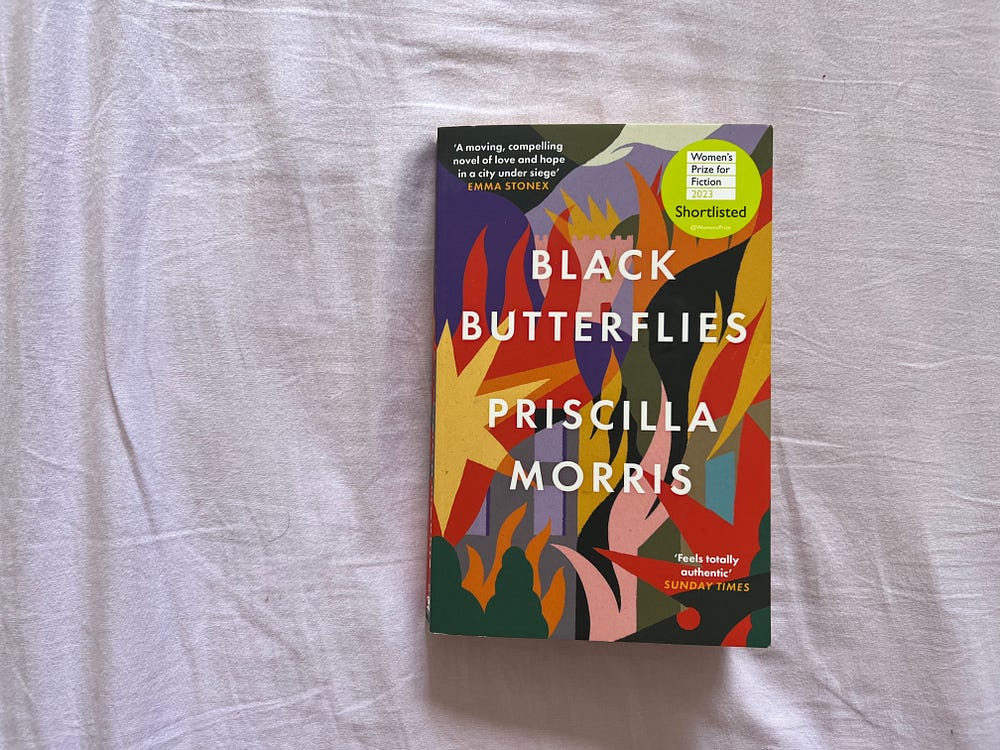
Disclaimer: Please note I received a copy of this book from the publisher in exchange for my honest review.
As one of the shortlisted books for this year’s Women’s Prize for Fiction, I expected Black Butterflies to be a valuable read. What I didn’t expect, though, was how important, relevant, and deafening this story truly is. During the time ridden with conflict that we find ourselves in, now’s the moment for Priscilla Morris’s incredible story to shine.
Black Butterflies is a character-driven novel about Zora, a painter caught in the siege of Sarajevo, who experiences first-hand the tragedy, destruction, and helplessness of war. The book starts with Zora’s husband and elderly mother preparing for a trip to England, to visit Zora’s daughter, Dubravka, and her family. Zora decides to stay behind and join them later. What Zora never expects is for her beloved city to be taken over by rebel forces and armed military, rendering her hostage in her own home.
We follow Zora and her close friends left behind in a constantly attacked Sarajevo, as they adapt to this new, unfathomable reality, and as their basic needs and rights are being taken away one by one. The war story starts with a powerful scene of a friendly dinner, where Zora and her neighbours gather to celebrate one of their group. As they talk and rejoice in the abundance of food, the floor above them gets shelled and everything comes crashing down.
This is how life as they know it starts folding into itself, becoming smaller and more dangerous, the sound of explosions taking over birdsong each morning.
The Power of People During War
The true value of this story is in showing just how resilient people are in finding something to live for.
The siege of Sarajevo is dark, violent, bloody, it takes away all of our characters’ freedoms, it leaves bodies behind in the streets, and it burns universities and libraries. The plot is developing in a dark, dusty context, with sounds of guns and explosions disrupting what’s left of the civilians’ lives.
But this is not just another account of war, it transcends way beyond that. Black Butterflies kept me hooked, clutching at the pages as I strived to find out more and more about Zora’s daily life in Sarajevo. I longed for her beautiful moments of friendship with Mirsad and her other neighbours. My heart melted every time Zora gave painting classes to her little neighbour, Una, a seven-year-old who had no business walking close to walls to avoid being gunned down. A child who deserved to live her young years away from death and hatred.
I hoped with all my might that Zora would continue to teach art at the university, and that her students would keep coming. I was greedy for all the ways in which she kept painting, kept sculpting, kept clutching at her dreams.
Living away from conflict can render you numb to what really goes on in war zones. We associate wars with men in uniform gunning each other down. We associate it with violence, blood, noise, and trenches. But we rarely think of the civilians caught in-between. How do they go on living? How do they adapt? How do they walk down the street?
Priscilla Morris’s most outstanding success with this book is, in my opinion, how she created such a strong, self-sufficient main character, that following her daily life in Sarajevo is enough. You don’t hope, as the reader, for an end or an escape route for Zora. You just take it one day at a time, just like she does.
Women’s Prize for Fiction 2023
The winner of the Women’s Prize for Fiction 2023 will be announced tomorrow, 14 June. To find out more about other books on the shortlist, visit the Women’s Prize for Fiction website.
 Coffee Time Reviews