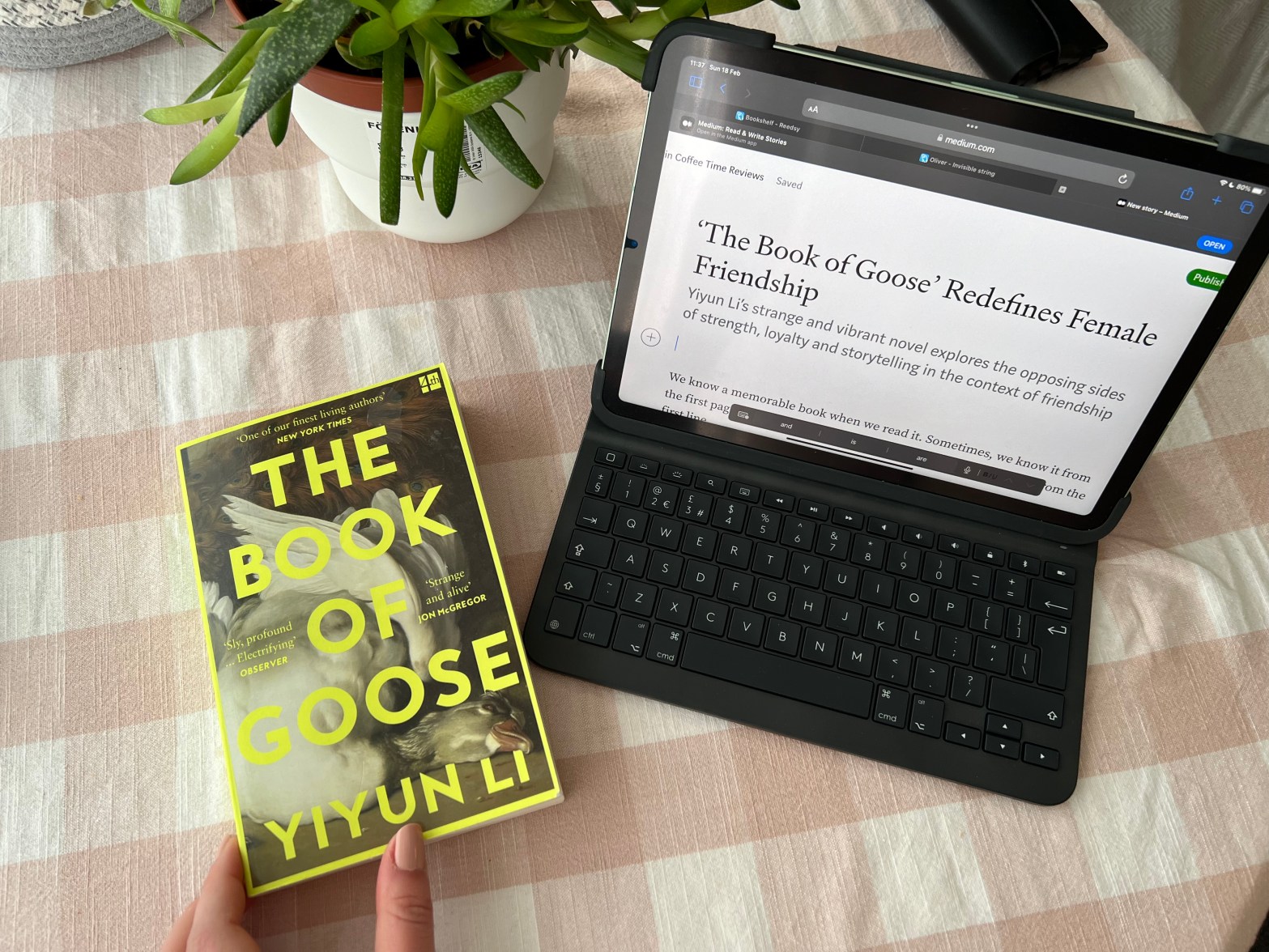
We know a memorable book when we read it. Sometimes, we know it from the first page. The Book of Goose by Yiyun Li is sure to stay with you from the first line.
I love a punchy first line. It sets the tone for the whole reading experience. Of course, with The Book of Goose, the title is in itself a whole thing to decipher. Going in, you have no idea what to expect. But a book that starts with such a first line can do one of two things: intrigue you or confuse you even further. This is how it starts:
You cannot cut an apple with an apple. You cannot cut an orange with an orange.
The Book of Goose, Yiyun Li
As you read on, you find out what this line means. It’s about contrast in human connection. The Book of Goose, as per its blurb, follows two best friends, Agnès and Fabienne, through their childhood and teens in the French countryside post-World War II.
The chapters are short, so it feels like popcorn-reading. But it is so profound, strange and moving, that it feels almost wrong to turn the pages quite so quickly.
Agnès is our narrator and she tells the story in retrospect, once she finds out that Fabienne has died in childbirth at 27, a fate shared by her eldest sister back when the girls were very young.
Stories are at the heart of their friendship. We follow the story of Fabienne’s unruly attitude to all living things and her wild imagination, the two sources of Agnès’s inexplicable fame. Because, as we find out early on, Fabienne made Agnès famous when they were still teenagers. I won’t divulge how.
The role of Fabienne pulling the strings and Agnès playing along makes perfect sense to the type of characters they are. Even in telling the story, Agnès has this echo-like trait, as if Fabienne is speaking through her.
The girls are incredibly different. One is clever in a cruel way, making reality play by her own rules, while the other is witty in a solemn way, taking life as it is and knowing when to give in.
My name is Agnès but that is not important. You can go into an orchard with a list of names and write them on the oranges, but what difference does it make? What matters to an orange is its orange-ness. The same with me.
The Book of Goose, Yiyun Li
Fabienne insults her friend constantly, saying she is stupid and an idiot. This is an interesting dynamic hardly explored in female friendships. We don’t often call each other names to our faces. And when we do, the other doesn’t usually embrace or accept our harshness.
But Agnès almost revels in Fabienne’s slander. She knows that her role in the friendship is to ask questions and bravely show her confusion at Fabienne’s antics. She knows Fabienne depends on this, it’s one of the roots that allow her to function.
All throughout their childhood and teens, the girls play pretend. They pretend they’re other people, they make up other worlds and inhabit them, they lay on gravestones until they turn “cold as death” just to test the limits of their bodies.
It is when this ability to play their games and live in their imagination runs dry, that the girls drift apart. But here’s the catch: Fabienne is the game master and Agnès just a player. This is why losing Fabienne makes Agnès become lost herself. Now she has all the choices and freedom. What to do, without Fabienne to decide for her?
I knew I could never see anything she saw and it was for that reason that I could have no other friend but Fabienne.
The Book of Goose, Yiyun Li
We get an insight into how Agnès’s fame came to be, where it took her, from Paris to England and finally America, and how she felt living through it all. We see little snippets of life without Fabienne and we finally get an understanding of why Fabienne did it all.
All I will say about the ending is that it left me having to process it for days. It’s easy, with a strong and well-defined character like Fabienne, to think she did it all for a laugh. She seems superficial and ruthless, never thinking about consequences. Fabienne never needs a reason.
When you do find out the reason, then, it takes time to ponder it. It’s an incredibly painful reason that makes perfect sense. It isn’t until the last page that Fabienne’s character becomes whole.
I hope this review convinces you to read The Book of Goose. It was an experience like no other for me. The chapters are short and no-nonsense, so it feels like popcorn-reading. But it is so profound, strange and moving, that it feels almost wrong to turn the pages quite so quickly.
 Coffee Time Reviews